Tuesday, April 12, 2016

Project 8: Two Portraits

 Commercial
This is my good friend Isabel from Italy. I took this picture in the Botanical Garden in Coimbra, Portugal. This photo is selling sunglasses, and the colorful pattern of her shirt could suggest selling clothing. A normal brand would sell both of these things.

Fine Art
This is my host sister Monica on Christmas day. My host family and I went around to 8 beaches that day on the coast. I think her eyes look very intense and her face portrays a lot of emotion, and the hair and adds to the photo and mood. I think she looks very intense and the black and white adds more to the intensity and mood of the photo.

Monday, March 28, 2016

Project 8: Two Portraits Prework


Fine Art

Brock Elbank
Born in England, currently living in the London, United Kingdom.

I love this body of work because it shines a spotlight on what is considered beautiful and what is not, the standards of society when it comes to looks. Brock described this project as deeply moving because he got to work with women who had been struggling with their freckles, and he thought they were beautiful. He said that many of them hated them, or grown to like them in adulthood. I think this body of work shows that different is beautiful, and these people's freckles makes them unique.


Alexander Yakovlev
Russian photographer out of Moscow. While his university education is in law, his passion is dance photography.

I love these photographs because they give the chance to appreciate the art of the moving human body, and the grace of ballet. This series captured movement really well, like the flour in the photos is very well defined and not blurry at all.  The passion and emotion these women show through their art form is absolutely stunning. I loved the use of color in these photos, how he edited them for one to seem dulled out, one very effective black and white, and one with deeper, more vibrant color. 


Magazine 


Elle Magazine
I loved this photo, and it really stood out to me because while it is Selena Gomez, the photographer managed to maintain a fine art feeling to the photo. This is a contrast to many of the other magazine photos of Selena, which aren't very artistic and subtle, but more like typical magazine covers with lots of colors and are very mainstream commercial. I loved this one because it seems understated, like the photo really relies on Selena's beauty and pose, along with editing. It is clearly still a magazine photo where they are trying to sell something, as you can see by her dress. The whites have clearly been brought way up to draw attention to it, and the colorful patters make a statement. Her head isn't in the middle of the photo like many mainstream covers are, but the dress takes up the majority of the image. 

 
Garage Magazine
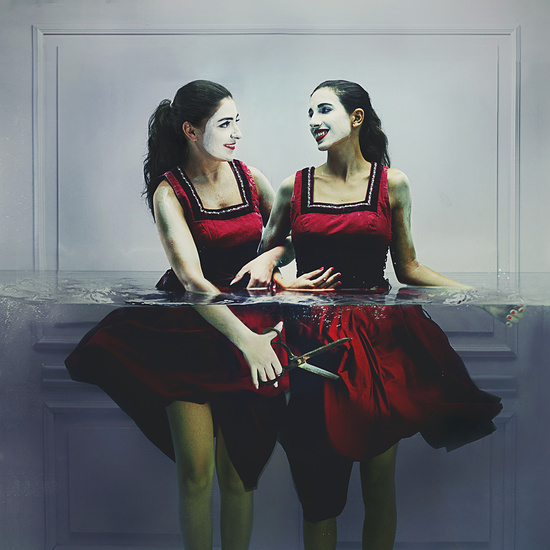
This photo is the most interesting and bizarre that I found. 


Saturday, March 19, 2016

Project 7: Surrealism and Photo Montage Final

A Day on the Hilltop

For this project I wanted to start with an image that had multiple dimensions. I like the layers of the rocks and thought they would converge nicely with the church walls. I like that the image had several things going on: cliff, sea, sky, grass. I chose to blend things into the cliff walls I think it gave it a really surreal effect, since they meshed well. I had gone through my photos and picked the ones that I thought could work best with a surrealist style photo. I picked the buildings I took in Holland because I knew I wanted to put them on top of the cliffs, and I got the huge church in Cologne, Germany, and I liked it because it was taken from below and has a bugs eye perspective. I put a peacock in the sky behind a cloud because why not. I put a swan on the moon, because I thought it added an artistic touch, and I gave the moon an arm because hey, this is surrealism.

Thursday, March 3, 2016

Project 7: Surrealism and Photo Montage Prework

Surrealism:  /səˈrēəˌlizəm/, noun

  1. A 20th-century avant-garde movement in art and literature that sought to release the creative potential of the unconscious mind, for example by the irrational juxtaposition of images.

Major Artists: Salvador Dali, Max Ernst, Andre Masson, Alberto Giacometti, Rene Magritte


Joan Miro
Spanish painter, sculptor, and ceramicist born in Barcelona. (1893-1983)
Harlequin's Carnival (1924)
Oil on canvas
Dutch Interior (1928)
Oil on canvas

Yves Tanguy
French painter born in Paris, France (1900-1955)
Mama, Papa is Wounded! (1927)
Oil on canvas
Indefinite Divisibility (1942)
Oil on canvas


Meret Oppenheim
Swiss painter and sculptor, born in Berlin-Charlottenburg, Germany. (1913-1985)
Pelzhandschuhe (1936)
Fur covered plastic hands
Luncheon in Fur (1936) 
Fur covered cup

Modern Surrealist Artists


Lebanese Conceptual Photographer
The Unseen

The Unseen

 The Unseen


The Unseen


Christopher McKenny
Conceptual artist from Pennsylvania specializing in 
horror surrealist photography.

Untitled
Self Made Ghosts
Just an Illusion #205
Self Made Ghosts


19 year old conceptual photographer, recently graduated from 
high school, now attending U of Georgia studying photo journalism.
 Chaos Theory
Untitled


Headrush

Headaches


The Five Stages of Grief

Limbo

Illume


Photographer and retoucher from Sweden based in Prague, Czech Republic, and Sweden.

 Set Them Free

The Architect

Dreamwalking

Landfall

Drifting Away

Cut and Fold


Sunday, February 28, 2016

Project 6 - Alternative Process Through Digital Means

WET PLATE COLLODION
An intricate process which required the photographic material to be coated, sensitized, exposed and developed within the span of about fifteen minutes, necessitating a portable darkroom for use in the field.

CYANOTYPE
The cyanotype is made up of two simple solutions, potassium ferricyanide and ferric ammonium citrate. They are mixed with water separately and then blended together in equal parts. You prepare paper, card, textiles or any other naturally absorbent material is coated with the solution and dried in the dark. Objects or negatives are placed on the material to make a print. The cyanotype is printed using UV light, such as the sun, a light box or a UV lamp. After exposure the material is processed by simply rinsing it in water, a white print emerges on a blue background. Then dried and admired.

GUM BICHROMATE
Gum bichromate printing involves creating a working emulsion made of three components, gum arabic, a dichromate (usually ammonium or potassium), and pigment. The emulsion is spread on a support, such as paper, and allowed to dry. A negative or matrix is then laid over top the emulsion and exposed to a UV light source. Usually a contact printing device or a sheet of heavy glass to ensure even, constant contact is employed. The light source will harden the dichromate in proportion to the densities of your negative. After exposure, the paper is placed in a series of plain water baths and allowed to develop until the unhardened portions of the emulsion have dissipated.


ORIGINAL ARTWORK


Wet plate collodian
For this photo I first brought the image into photoshop, and resized the photo so that it had a resolution of 72ppi and was 10 inches vertically. I then made a background copy and went into the filter settings and put a lens blur on the photo. I then added a layer mask and took my paintbrush to bring back some clarity to the Lincoln statue, but left the background faded. I used a less concentrated brush to add some gradient between the clear statue and fuzzy background. I then added a new layer, which I completely filled black using my paint bucket tool. I used the lasso tool to put a vignette on the photo. I then turned the photo black and white, but but a brownish tint on it. I then brought three different textures into photoshop, and one by one I copied the textures onto the photo and changed the blending mode for each one. Finally, I found an image with a cool border on google images that I saved to my desktop and then layered it onto my statue image, and then using the eraser tool I erased the subject of the second photo so that all that was left was the cool border around my photo.

Wet plate collodian


Cyanotype
I made this image by first bringing it into photoshop and creating a new layer. I filled this layer with white using my paintbrush tool. I then found a brush I liked and took away white from the middle of the photo, and tried to make some gradient between completely solid and the white. I then turned the photo on the cyanotype option, and added some of my own blue tint to it.

 Daguerreotype
For this image I brought the picture into photoshop, and created a new layer. I filled this layer with black using my paint bucket tool. I then used the lasso tool to get a nice vignette on the photo. I then turned the photo black and white, using a brownish tint on the photo. I then used several textures on the photo, which I brought in by copying and pasting. I changed the blending mode on them all, using hard light, soft light, and multiply. I changed the opacity on some of them as well so they wouldn't over power the photo and make it unrecognizable.
Daguerrotype

Gum bichromate
First I brought this image into photoshop and resized the image to 72ppi and make its longest edge 10 inches. I then make a background copy, and made the image black and white. I then gave it a blue tint. Then I made a new layer, and used my paint bucket tool to fill the layer with white. Then I muted the background copy. I then got a black brush and filled the center of the image with black, leaving white on all sides. Then I unmuted the background copy, and I had the image with the interesting edges. Then I made a new layer, and using a green brush I filled in the image with the green. I changed the blending mode from normal to hard light to get it to layer nicely with the background layer. I then did the same thing with a new layer using red. I changed the blending mode yet again, and repeated this process about 5 times with yellow, more blues, and purples to achieve this final image.